


Table Of Contents
The “Laptop Lifestyle” is the dream for millions. The idea of closing your laptop at 2:00 PM to go for a hike, or working from a coffee shop in Bali, is intoxicating. But when you start researching how to achieve this, you hit a fork in the road.
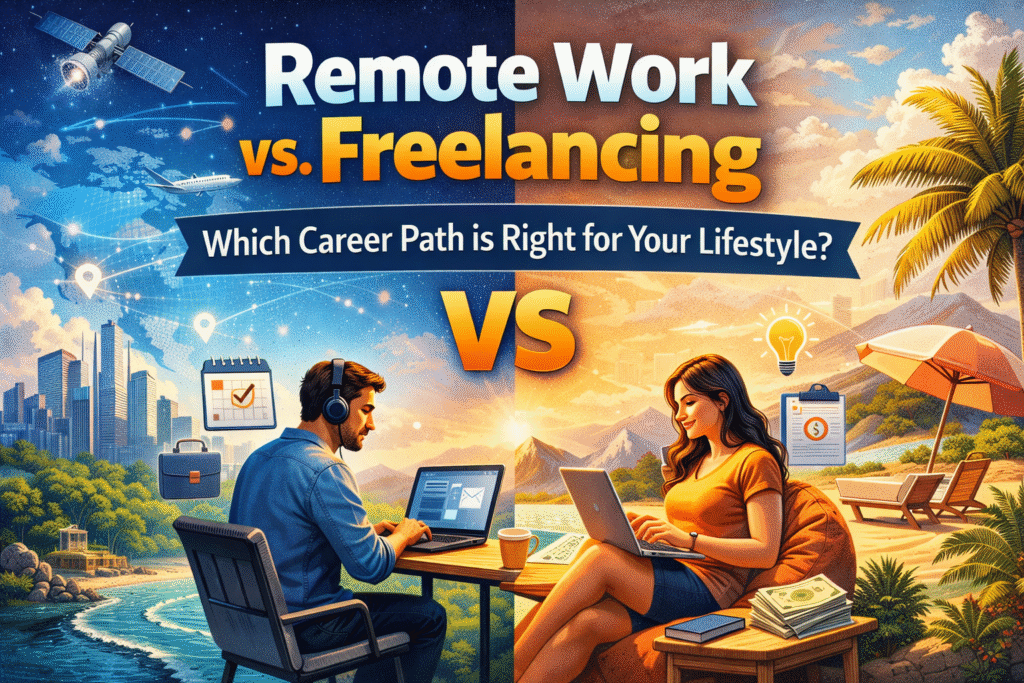
On the left, there is Remote Employment: Getting hired by a company, receiving a salary, but never stepping foot in an office.
On the right, there is Freelancing: Starting your own service business, finding clients, and eating what you kill.
Many beginners use these terms interchangeably, but they are legally, financially, and practically opposites. Choosing the wrong one can lead to burnout, tax nightmares, or a lifestyle that creates more stress than the 9-to-5 you are trying to escape.
In this massive guide, we are going to tear down the differences between being a Remote Employee and a Freelancer, covering everything from income potential and tax implications to daily routines and long-term career growth.
Chapter 1: Definitions and Distinctions
Before we debate which is better, we must define what they actually are. The distinction isn’t just a mindset; it’s a legal status.
The Remote Employee (The W-2 Worker)
A remote employee is exactly the same as an in-office employee, minus the commute. You sign an employment contract. You have a boss. You likely have set hours (e.g., 9 AM to 5 PM EST). You are part of a team, you attend meetings, and you receive a steady paycheck regardless of how profitable the company was that month.
The Freelancer (The 1099 Contractor)
A freelancer is a business owner. You do not have a boss; you have clients. You do not receive a salary; you send invoices. You are not paid for your time; you are usually paid for your output or the project. You are responsible for your own equipment, software, and taxes.
Also Read This : The Ultimate Guide to Remote Work 2026: How to Start, Where to Look, and What to Expect
Chapter 2: The Case for Remote Employment
For many, remote employment is the “Holy Grail.” It offers the safety of a corporate job with the comfort of home.
1. Stability and Predictability
The biggest advantage is the paycheck. Whether you write 500 lines of code or 50, you get paid the same on the 1st and 15th of the month. This makes getting a mortgage, planning vacations, and budgeting significantly easier.
2. The Benefits Package
In the US and many Western nations, healthcare is tied to employment. Remote jobs often come with:
- Health, Dental, and Vision insurance.
- 401(k) matching or pension contributions.
- Paid Time Off (PTO) and Sick Leave.
- Stipends for home office equipment.
3. Psychological Safety
When you clock out at 5 PM, you are done. You don’t have to spend your evenings looking for new clients or marketing yourself. The mental load is lower because someone else (your boss) is responsible for finding the work for you to do.
The Downside of Remote Employment
- The “Green Dot” Anxiety: You often feel pressured to be “active” on Slack or Teams to prove you are working.
- Limited Income: Your raise is capped at 3-5% per year unless you get a promotion.
- Politics: You still have to deal with annoying coworkers and corporate bureaucracy, even via Zoom.
Also Read This: Entry-Level Remote Jobs: How to Get Hired with No Experience (Step-by-Step Guide)
Chapter 3: The Case for Freelancing
Freelancing is the ultimate form of freedom, but it comes with the ultimate form of responsibility.
1. Uncapped Earning Potential
As an employee, you trade time for money. As a freelancer, you trade value for money. If you get faster at your job, you earn more per hour. You can raise your rates whenever you want. If you want to make an extra $2,000 this month, you can just find another client.
2. True Time Freedom
Remote employees often still have to sit at their desks from 9 to 5. Freelancers generally work asynchronously. If you want to work from 4 AM to 8 AM and then take the rest of the day off to surf, you can—as long as the deadline is met.
3. Tax Advantages (The Hidden Bonus)
Freelancers are businesses. This means they can deduct expenses before paying taxes.
- Home office deduction.
- Internet and phone bills.
- Laptops and software.
- Business travel/meals.
The Downside of Freelancing
- Feast or Famine: You might make $10,000 in January and $500 in February. You must be a good saver.
- The “Hustle” Never Stops: You aren’t just doing the work; you are the CEO, the marketing department, the IT guy, and the janitor.
- No Paid Time Off: If you get sick or want to take a vacation, you don’t get paid. Period.
Chapter 4: The Financial Showdown
Let’s look at the math. Which path makes you richer?
The $100k Myth
Earning $100,000 as an employee is very different from earning $100,000 as a freelancer.
- Employee: You pay income tax, but your employer pays half of your Social Security and Medicare taxes. You also get benefits worth ~$15,000.
- Freelancer: You pay “Self-Employment Tax” (an extra 15.3% in the US) on top of income tax. You pay for your own health insurance.
Verdict: To have the same spending power as a $100k Remote Employee, a Freelancer usually needs to bill about $125k to $135k to cover taxes and insurance.
Chapter 5: Personality Type Assessment
Which path fits you?
You belong in a Remote Job if:
- You value security over autonomy. You sleep better knowing exactly how much money is coming in next month.
- You hate sales. You just want to do the work, not pitch yourself to strangers.
- You struggle with time management. You need external deadlines and a boss to keep you on track.
- You are extroverted. You enjoy the camaraderie of a team, even virtually.
You belong in Freelancing if:
- You are a risk-taker. You are okay with a bad month because you know you can have a great month later.
- You are a “Generalist.” You enjoy variety and get bored doing the same thing for the same company every day.
- You have a niche skill. Highly specialized skills (like AI development or direct-response copywriting) pay much better on a contract basis than a salary basis.
- You want to travel heavily. Freelancing usually offers better flexibility for Digital Nomads across different time zones.
Chapter 6: The Third Option – The “Side Hustle” Transition
You don’t have to jump off a cliff. The smartest way to transition is the Hybrid Model.
Keep your remote (or office) job. Start freelancing in the evenings (6 PM – 9 PM) or on weekends.
- Pros: You build a client base without financial risk.
- Cons: You will be working 60+ hours a week for a while.
Chapter 7: Industry Specifics
Some industries favor employees, while others favor freelancers.
- Tech/Dev: Good for both. High salaries for employees, massive day rates for contractors.
- Writing/Creative: Heavily skewed toward Freelancing. It is hard to find high-paying full-time writing jobs, but easy to find high-paying clients.
- Admin/HR: Skewed toward Remote Employment. Virtual Assistant roles exist, but HR is usually an internal role.
Conclusion: There is No Wrong Choice, Only Different Seasons
Many people start as remote employees to learn an industry, transition to freelancing to maximize their income, and eventually return to employment for stability as they age or start families.
The beauty of the digital economy is that you are not locked in. You can try freelancing for a year, and if you hate the instability, you can take those new skills and get a better remote job than you had before.
Ready to choose? If you picked Freelancing, read our next guide: [How to Find Your First Client in 7 Days]. If you picked Remote Work, check out: [The Top 20 Remote Companies Hiring Now].
FAQ: Common Questions
Q: Is it harder to get a mortgage as a freelancer?
A: Yes. Banks typically require 2 years of consistent tax returns from freelancers to prove income stability. Remote employees just need a pay stub.
Q: Can I do both?
A: Yes, “Overemployed” is a growing trend where people work two remote jobs, though it is risky. Freelancing on the side is safer and usually legal (check your employment contract for non-compete clauses).
Q: Which one is better for mental health?
A: It depends on your triggers. If financial insecurity causes you anxiety, freelancing is bad for your health. If being micromanaged causes you anxiety, employment is bad for your health.